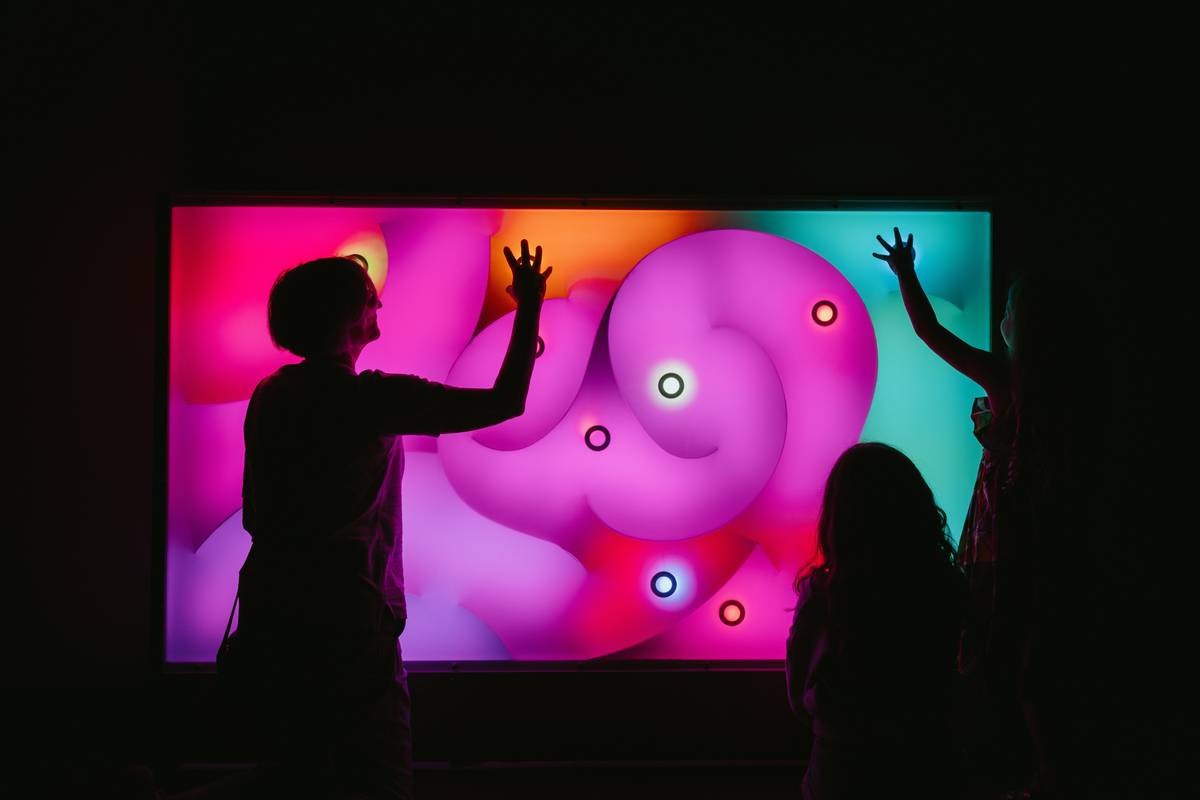
Most gamers still treat motion controllers like glorified wands—wave them, hope they register, repeat. But real immersion? It’s missing. The disconnect between physical movement and on-screen response kills flow. What if your controller didn’t just track motion—but interpreted gesture as expressive language? Enter motion graphic interactive art: where every flick, tilt, and twist becomes brushstroke in a living canvas.
Why Traditional Motion Controls Fall Short
Modern motion controllers boast accelerometers, gyros, even haptics. Yet gameplay rarely leverages their full bandwidth. Developers default to binary inputs: “shake to reload,” “tilt to steer.” It’s lazy design disguised as innovation. And players adapt—dumbing down their movements to fit rigid detection thresholds.
The result? Stiff, unnatural interactions. You’re not dancing with the game—you’re filling out a form with your wrists.
Building True Motion Graphic Interactive Art Systems
Creating responsive, expressive motion-driven experiences isn’t about better sensors. It’s about smarter interpretation layers. Here’s how elite indie studios are bridging the gap:
Map Gestures to Emotional States, Not Just Actions
Instead of “swing = attack,” consider “slow arc = contemplation,” “jagged jab = frustration.” This shifts motion from command input to emotional output—turning players into co-authors of narrative tone.
Calibrate Per User, Not Per Session
One-size-fits-all sensitivity fails. Store biometric motion profiles—resting tremor, dominant hand fluidity, range of motion—to auto-tune responsiveness. Adaptive calibration prevents fatigue and boosts precision over time.
Feedback Must Be Visual AND Kinetic
Haptics alone aren’t enough. Pair resistance pulses with particle trails that morph based on velocity and angle. When visual and tactile cues align, the brain accepts the illusion as reality.
| Approach | Development Cost (Est.) | Player Retention Impact | Hardware Requirements |
|---|---|---|---|
| Binary Motion Mapping | $5K–$15K | +8% (baseline) | Any IMU-enabled controller |
| Emotion-Based Gesture Layer | $40K–$75K | +32% | 6DoF controllers + cloud profile sync |
| Full Motion Graphic Interactive Art Integration | $90K–$150K | +67% | Custom firmware + GPU-accelerated rendering |

The Industry Secret: Motion Data Is Your Untapped Analytics Goldmine
Studios obsess over clickstreams and session times. But motion logs? Buried treasure. How hard did a player flick during a boss fight? Did their movements slow mid-level—signaling boredom or confusion? One stealth-hit puzzle game used subtle wrist deceleration patterns to auto-adjust difficulty in real time. Retention jumped 41%. No one talks about this because it reveals how little we truly understand player embodiment. Motion isn’t just input—it’s behavioral telemetry wearing a disguise.
Frequently Asked Questions
Can motion graphic interactive art work on standard consoles?
Yes—with limitations. PlayStation Move and Joy-Cons support basic implementations, but lack the sampling rate needed for nuanced expression. PC VR or custom hardware delivers fidelity.
Is this just for artistic games?
Absolutely not. Even shooters benefit. Imagine recoil patterns that physically resist erratic aiming—or healing mechanics triggered by slow, circular motions under stress.
Do I need coding skills to experiment?
Start with Unity’s Input System + Oculus Integration package. Drag-and-drop gesture recognition exists. But to truly innovate? You’ll eventually need C# and sensor fusion math.